Skip to content

Support

5.1k Topics 22.0k Posts

Questions about installing, configuring and using NetXMS.

  • Periodically - multiple agents tunnels appear as unbound

    1
    0 Votes
    1 Posts
    16k Views
    B
    Hello, in the recently passed few weeks we noticed brand new issue: one or few of the agent tunnels appear as unbound without anyone changing anything. Ofcourse data collection stops at that time until you manually bind the tunnel again to the appropriate node. We use the agents as proxies, so lots of nodes are affected on each occurence. Any ideas are welcome on how to approach the troubleshooting of this issue! Thanks!
  • agent tunnels tls failure

    3
    0 Votes
    3 Posts
    24k Views
    V
    Any client OS. I gave up on  Ubuntu 18.04. Installed server on Windows, worked on first try.
  • Trying to set up SSO with Apereo CAS

    2
    0 Votes
    2 Posts
    19k Views
    F
    Soooo, after hundreds of LoC and hundreds of grey hair later, I finally managed to get the Apereo CAS working with NetXMS Web UI. In order to help other users, who also struggle to get this to work on their setup, I answer my questions from the original post by myself, give brief tips and try to keep it as general as possible. You will need the following Server Configuration variables set on your NetXMS server: "CASHost" - The hostname/IP facing to the CAS server; in case it is behind a proxy, configure the proxy let this hostname point to the CAS server (or the root folder of it's .war) "CASPort" - The port which will be appended to 'CASHost' for the https-request (Again, when behind a proxy, use the port, which is configured in the proxy to point towards the server) "CASService" - The 'serverId' configured in CAS, NetXMS uses to identify intself at CAS "CASTrustedCACert" - The path to the CA certificate of the CAS server (actually, I'm not 100% sure about that, but it worked for me to just use the .crt file, which I generated for the CAS-domain) "CASValidateURL" - The path extension to append to hostname and port to get CASHost:CASPort/CASValidateURL. At this resource, NetXMS requests CAS to validate the received service ticket. (With CAS 6.0.x, this is by default '/cas/serviceValidate') (From this point, I will use cas.example.com as CAS-hostname and netxms.example.com as NetXMS-WebUI hostname -> this will also be its serviceId at CAS) "How does the Webapp handle the SSO session?": After loggin into CAS at cas.example.com/cas/login?service=netxms.example.com, CAS will redirect to netxms.example.com?ticket=ST--something The Webapp then attempts to connect to the NetXMS server defined either in nxmc.properties or by the 'server' query parameter (otherwise, 127.0.0.1 is chosen) and provides the service ticket to be used as SSO login. The NetXMS server then tries to connect to the CAS server's service validation endpoint defined by the three variables above, using HTTPS and to verify its SSL certificate (here: cas.examlpe.com/cas/serviceValidate?service=netxms.example.com&ticket=ST-[...]-something The provided parameters 'service' and 'ticket' are used for validation. If they are valid, NetXMS tries to extract the XMS tags cas:authenticationSuccess for confirmation and cas:user to determine the username, from CAS-server's response. Successful login is only possible, if the username extracted from cas:user is present in the NetXMS user database, otherwise, access will not be granted. 1.1 "Is there a special URL to which CAS needs to redirect upon successful login?": More or less: netxms.example.com?ticket=ST-[...]-something (The URL to reach the login-page of the NetXMS WebUI, extended by a query string containing at least the ticket-parameter) This is done by default by CAS, so nothing to do here. 1.2 "Which attributes are needed from and for CAS?": From CAS, only the service ticket (and optionally, the NetXMS server, but this can by set in nxmc.properties) To CAS, serviceId (CASService configuration variable) and ticket, additionally, the username in CAS should also be present in NetXMS user database 1.3 "Is SLO (single log out) also implemented?": So far, I did not see anything like this. After logging out from a NetXMS SSO session, the current service ticket may be expired (depending on the CAS configuration), but the TGT (Ticket granting ticket) is not, so logging in again via the CAS interface will not prompt the login dialog of CAS, until cas.example.com/cas/logout is requested. 2 "How is the user management handled?: " The username extracted from the validation response (cas:user, which is basically the principal id) is used to determine the representing user within the NetXMS database. Basically, it is just as logging in as this user. 2.1 "Does te user still need to be present in the NetXMS database?: " Yes  2.2 "If not, how are access rights handled?: " As 2.1 returns 'Yes', this is pretty self explaining, given that you know how NetXMS internal user-/group management works. 3 "Can the official documentation be extended with this topic?": I don't know, they could refer to this forum thread, maybe  ;D Hopefully, this helps some people setting up their CAS/NetXMS infrastructure. (Btw.: Debug level 9 in server logs gives some good information about this. Keep an eye open for SSO error codes (0,-1,-2,-10 ... -20 ...) and messages - their handling can be checked in the file 'cas_validator.cpp' of the sourcecode, which can provide some help in determining, what is going on). The file 'ApplicationWorkbenchAdvisor.java' in [SourceCodeRoot]/webui/webapp/Core/src/org/netxms/ui/eclipse/console/ shows, how the login method is chosen, depending on the URL parameters provided upon accessing the login page of the WebUI. Another tip: Service ticket validation needs to be done via HTTPS - a self-signed certificate is sufficient in a testing environment. Feel free to ask, if questions come up  Thank you and kind regards, fbu
  • cisco Nexus 3548 - Failed to get switch forwarding database

    1
    0 Votes
    1 Posts
    16k Views
    E
    Hello Having some trouble with nexus 3548 switch, i would like to see attached neighbours (fdb) but netxms fails to read the database. Its only detecting 2 other cisco switches via LLDP, but not devices directly attached to switch. [20.06.2019 10:08:37] **** Poll request sent to server **** [20.06.2019 10:08:37] Poll request accepted [20.06.2019 10:08:37] Starting topology poll for node Sw 1 [20.06.2019 10:08:37] VLAN list successfully retrieved from node [20.06.2019 10:08:37] Failed to get switch forwarding database [20.06.2019 10:08:37] Link layer topology retrieved (2 connections found) [20.06.2019 10:08:37] Updating peer information on interfaces [20.06.2019 10:08:37]    Local interface Ethernet1/47 linked to remote interface Core 1 [20.06.2019 10:08:37]    Local interface Ethernet1/48 linked to remote interface Core 2 [20.06.2019 10:08:37] Link layer topology processed [20.06.2019 10:08:37] Finished topology poll for node Sw 1 [20.06.2019 10:08:37] **** Poll completed successfully ****
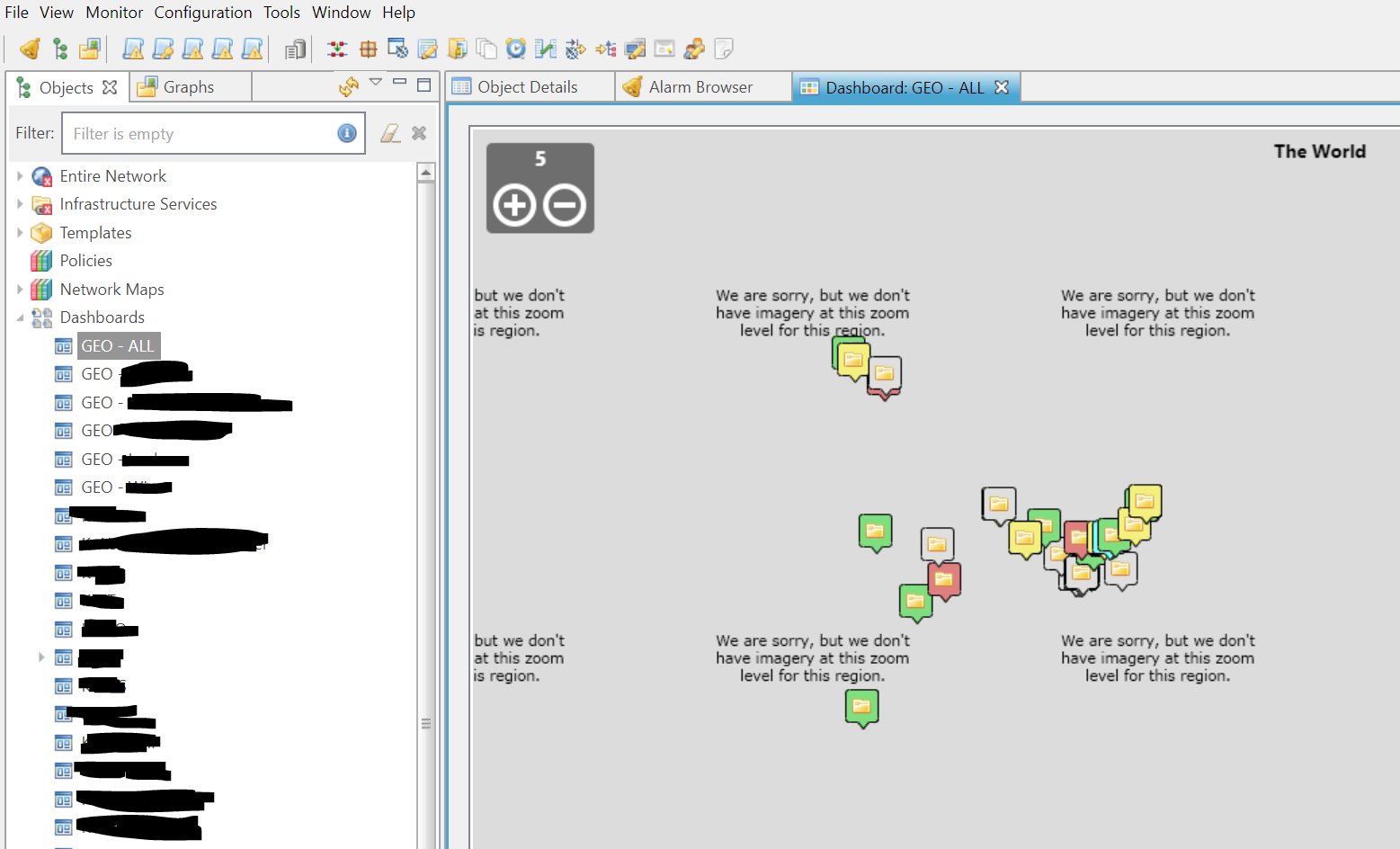
  • Dashboard Geo-Map error "no imagery at this zoom level"

    3
    1
    0 Votes
    3 Posts
    20k Views
    C
    @victor said in Dashboard Geo-Map error "no imagery at this zoom level": Hi, looks like NetXMS client is blocked on OSM tile server. We plan to setup our own tile server. In the meantime, you can try to set tile server to https://maps.wikimedia.org/osm-intl/ (server configuration parameter TileServerURL). Best regards, Victor Victor, thank you. The workaround is doing fine. Do you have any details on the planned tile server yet?
  • Alert based on syslog amount

    3
    0 Votes
    3 Posts
    19k Views
    E
    That was simple solution, thanks
  • Linux agent not returning any data

    3
    0 Votes
    3 Posts
    16k Views
    V
    Hi, looks like bug in static build. Try to use non-static binaries (they should run on almost any distribution as well). Best regards, Victor
  • Website monitoring doesn't work

    1
    0 Votes
    1 Posts
    13k Views
    I
    Hello, I'm using 2.2.15 version server/agent. I've tried to configure DCI and network service to monitor website, but neither dci or network service work. DCI the status is always 3 and network service always 5. In logs doesn't show any error. DCI Configuration: ServiceCheck.HTTP(IP,80,/index.php,domain,^HTTP/1\.[01] 200.*) SubAgent = portcheck.nsm Network service: type http, port 80, request is <domain>:/index.html and response is ^HTTP/1\.[01] 200.* Any help is appreciated! Thank you!!
  • Migrating to a new server - can I take existing data?

    7
    0 Votes
    7 Posts
    30k Views
    P
    Went with export / import. 1.4GB export file took about an hour to import - VM built as 4 core 12GB E2680 V4 CPU with all Flash storage - everything was local (iscsi to SAN). Included collected data. Panicked when I started the console locally and pointed it at the new server - error.:(  Helps to start the NetXMS service first Everything was perfect - the only thing I had to do in addition to the import was to copy the MIBS across.
  • NetXMS crashing when adding ssh as data source

    7
    0 Votes
    7 Posts
    25k Views
    E
    Any ideas why netxms is crashing with ssh as data source?
  • DCI Template manual override

    15
    0 Votes
    15 Posts
    42k Views
    I
    Tursiops, It's work fine!!! Thanks a lot!
  • Grafana and java errors

    2
    0 Votes
    2 Posts
    12k Views
    J
    I narrowed the error down to the included json-20160212.jar (maven dependency?) I replaced this with json-20180813.jar json-20180813.jar works for non-table DCIs.
  • grafana tables

    3
    0 Votes
    3 Posts
    20k Views
    J
    Is this still true, that table DCIs are still unsupported? Here's the reason why I'm trying to use table DCI instead of instance discovery. I'm dealing with a hardware vendor that has an unusual method of handling interfaces. It maintains a fixed interface table size (64) for PTMP radio operations. When a client radio attaches, it does so at the next available ifIndex. In a situation where the client radio is detaching and re-attaching frequently, the ifIndex might change more rapidly than the server-InstancePollingInterval. I don't believe I can specify a custom InstancePollingInterval for a specific class of devices using a template. So in order to track the stats of a client radio over time, instance discovery will not work as expected. Let's say I do instance discovery using MAC address, and the ifIndex of a given MAC address changes. A new DCI would be created and the old DCI would be queued for deletion. That would be incompatible with the goal of retaining statistics over a long period of time. Our proposed workaround is simply to store the entire interface table, deleting rows where there is no client currently attached. This works as expected. We won't use NetXMS for visualization, however, as a given row/cell in the table can only be graphed (over time) by its row index, not by some chosen field (MAC address, in this instance). Unfortunately without the Grafana connector working for tables, I'm scratching my head of how to get the data back out of the NetXMS database and display it correctly. I'm open to other ideas -- and perhaps this is an opportunity for development sponsorship.
  • Wrong time on linecharts

    3
    0 Votes
    3 Posts
    14k Views
    M
    Hi Victor, netxms server and webserver are on the same machine, web console is opened from various windows 10 clients. Tomcat: Server version: Apache Tomcat/8.5.39 (Ubuntu) Server built:  Apr 10 2019 04:45:09 UTC Server number:  8.5.39.0 OS Name:        Linux OS Version:    4.15.0-51-generic Architecture:  amd64 JVM Version:    11.0.3+7-Ubuntu-1ubuntu218.04.1 Java version: openjdk version "11.0.3" 2019-04-16 OpenJDK Runtime Environment (build 11.0.3+7-Ubuntu-1ubuntu218.04.1) OpenJDK 64-Bit Server VM (build 11.0.3+7-Ubuntu-1ubuntu218.04.1, mixed mode, sharing) Best, Sebastian
  • DB of choice and sizing - feedback requested

    2
    0 Votes
    2 Posts
    13k Views
    V
    We have very good experience with PostgreSQL, that's definitely our recommendation. You may also try TimescaleDB - this is PostgreSQL extension optimized for time series data. We have added support for TimescaleDB recently and so far it shows significant performance improvement for large deployments. Best regards, Victor
  • TRAP defining - a million hours completed - in under a minute.

    1
    0 Votes
    1 Posts
    12k Views
    P
    After completing my first two traps in just over an hour, the prospect of doing the same for the 34,570 traps in my existing NMS was going to take forever - literally. Even if I limited it to the 3,000 critical was going to be too many - plus there is the 900 odd specifically customized as an absolute minimum was still way too many. And then it hit me..... NetXMS treats all PDU's / Varbinds the same - exactly the same!! All I needed to do was to take the "Unmatched trap" event and turn it into an Alarm. I simply added an Alarm definition based on that event - passed the varbinds across - and hey presto, all the traps I could ever need to configure into readable alarms now generate readable alarms (99% readable - transformations such as time ticks to Time format do not work - obviously). For those traps I want to format specifically, I can simply define them individually, but for the most part, I can simply use the default. The only real problem with doing this is that NetXMS passes the PDU's / Varbinds as %2 rather than as individual parameters.  I had a look at snmptrap.cpp to see if there were other variables with the individual values, but, for unmatched traps, it does not populate the PDU's into variables. If this was changed so that unmatched trap returned each of the PDU's / Varbinds / OID's from the trap individually rather than as %2 - this solution would mean that  I would probably never have to define another snmp trap again. I could simply display %1 \n %2 \n %3 \n etc. and see the trap content one line at a time - automatically. If I was able to have the OID of the trap converted into the trap description in the MIB - I would never define another trap again. Once I know what trap it is - I can work out pretty much what each PDU means. If this was too hard - I can always define an alert. The snmptrapp takes the OID of the trap and looks up the trap table to see if it is defined. All it would have to do is look up the MIB table to find the trap description for that OID - exactly as it does when adding a trap processor. Not a complete solution, but, a solution that would work for at least 28,000 of my traps. I do not consider these as features - they are simply simple options that would make trap processing much easier. Have them as two Server options: Unmatched_TRAP_as_one_var True False with False splitting up the PDU's into individual Unmatched_TRAP_lookup True False with True looking up the trap from the compiled MIBs (or a master list of all traps extracted from the compiled MIBs) Now here is the weird part - looking at the code in snmptrap.cpp - around lines 63 - 136 it looks like there is the capability for auto trap creation already existing. Given that my cooking is better than my coding and I would not recommend anyone eating my cooking, I cannot say for certain what NetXMS can already do - but it certainly looks like that everything above is already catered for already - except for splitting unmatched traps into individual variables rather than passing as %2. this just happens to be the one thing that would help the most. Anyway - just thought I would put it out there that trap processing can go from complete nightmare to absolute wonder with just a little lateral thinking - and one simple alarm definition
  • Total disk space in use of all servers

    13
    0 Votes
    13 Posts
    61k Views
    B
    It was set to 1.  I have no idea how it got set that way. I set it to 0 and restarted, and it produced results! Is there somewhere in the documentation about scripting that I missed? Thank you for your help! *** FINISHED *** Result: 27706007919104
  • Multiple wireless ap-s behind router

    2
    0 Votes
    2 Posts
    28k Views
    V
    Hi, try to open properties of already added device and set option "This is address of remote management node" on "Communication" page. Then try to addd another node with same IP address. It should work if both nodes does not report NAT IP as one of their interfaces address. Best regards, Victor
  • Problem with agent log: could not open

    5
    0 Votes
    5 Posts
    37k Views
    B
    Thanks for the help, that seemed to work, but I've got many other Windows servers with the exact same settings that work just fine. I appreciate the help.
  • NetXMS backups - what is the general consensus?

    3
    0 Votes
    3 Posts
    34k Views
    P
    We have Vsphere HA cluster and Commvault snapshot based backups. https://www.veeam.com/blog/why-snapshots-alone-are-not-backups.html Unfortunately, we do not have the Commvault PostgreSQL agent which means a DIY option. I have pg_dump working producing compressed files in Directory format so happy enough with that. *** my daily safety net ***  My uncompressed version produced the same size backup as nxdbmgr export - so happy enough with that as well. Having a just-in-case seems like a good idea and since I will be smash testing my VM (and host) to see how "recoverable" it is - I want to make sure I really can recover it - no matter what!! I will start with a snapshot though after first stopping NetXMS and PG - my ultimate fall back.