
Startup Script
-
I have discovered that my startup script on Debian 8.6 isn't working. It works fine when I run netxmsd directly, but not when I run it via /etc/init.d/netxmsd start. There are no log entries made that way.
Can I get someone's verified working script so that I can get mine running again?
-
I've also tried via systemctl.
root@netXMS:/etc/init.d# systemctl start netxmsd root@netXMS:/etc/init.d# systemctl status netxmsd â netxmsd.service - LSB: NetXMS server Loaded: loaded (/etc/init.d/netxmsd) Active: active (exited) since Fri 2016-11-11 08:07:06 CST; 4min 58s ago Nov 11 08:07:06 netXMS systemd[1]: Started LSB: NetXMS server initscript. Nov 11 08:08:47 netXMS systemd[1]: Started LSB: NetXMS server initscript. Nov 11 08:08:59 netXMS systemd[1]: Started LSB: NetXMS server. Nov 11 08:12:02 netXMS systemd[1]: Started LSB: NetXMS server. root@netXMS:/etc/init.d# ps aux | grep net root 28 0.0 0.0 0 0 ? S< Oct16 0:00 [netns] root 19584 0.0 0.0 5844 712 pts/0 S+ 08:07 0:00 tail -f -n 50 /var/log/netxmsd.log root 19616 0.0 0.0 12732 2304 pts/2 S+ 08:12 0:00 grep net -
I'm successfully use this one: https://github.com/netxms/packages-deb/blob/master/netxms-server.netxmsd.init
Which one do you use?
-
Hello ,
Check if the header of the startup script is full. I notice that the ubuntu script is not with the full header (see attachment). you can copy the header from one of the other scripts and it runs fine or use the script for ubuntu (if you are using debian) and other way around if you are using ubuntu.
Hope this help.
Best regards,
Adrian
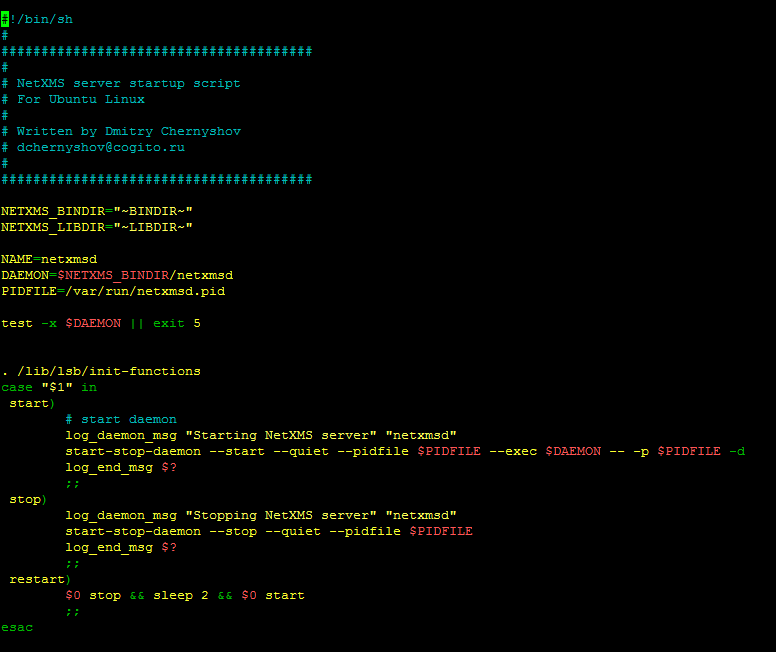
-
Looks like I use this one:
#!/bin/sh
# vim: syntax=sh
### BEGIN INIT INFO
# Provides:          netxms-server
# Required-Start:    $network $local_fs nxagentd
# Required-Stop:
# Default-Start:     2 3 4 5
# Default-Stop:      0 1 6
# Short-Description: NetXMS server
# Description:       Network monitoring daemon, which collect and process metrics
#                    from native and SNMP agents.
### END INIT INFO

# Author: Alex Kirhenshtein <[email protected]>

PATH=/sbin:/usr/sbin:/bin:/usr/bin
DESC="NetXMS server"
NAME=netxmsd
DAEMON=/usr/bin/netxmsd
DAEMON_ARGS="-d"
PIDFILE=/var/run/$NAME.pid
SCRIPTNAME=/etc/init.d/$NAME

# Exit if the package is not installed
[ -x $DAEMON ] || exit 0

# Read configuration variable file if it is present
[ -r /etc/default/$NAME ] && . /etc/default/$NAME

# Load the VERBOSE setting and other rcS variables
. /lib/init/vars.sh

# Define LSB log_* functions.
# Depend on lsb-base (>= 3.0-6) to ensure that this file is present.
. /lib/lsb/init-functions

#
# Function that starts the daemon/service
#
do_start()
{
        # Return
        #   0 if daemon has been started
        #   1 if daemon was already running
        #   2 if daemon could not be started
        start-stop-daemon --start --quiet --pidfile $PIDFILE --exec $DAEMON --test > /dev/null \
                || return 1
        start-stop-daemon --start --quiet --pidfile $PIDFILE --exec $DAEMON -- \
                $DAEMON_ARGS \
                || return 2
        # Add code here, if necessary, that waits for the process to be ready
        # to handle requests from services started subsequently which depend
        # on this one.  As a last resort, sleep for some time.
}

#
# Function that stops the daemon/service
#
do_stop()
{
        # Return
        #   0 if daemon has been stopped
        #   1 if daemon was already stopped
        #   2 if daemon could not be stopped
        #   other if a failure occurred
        start-stop-daemon --stop --quiet --retry=TERM/30/KILL/5 --pidfile $PIDFILE --name $NAME
        RETVAL="$?"
        [ "$RETVAL" = 2 ] && return 2
        # Wait for children to finish too if this is a daemon that forks
        # and if the daemon is only ever run from this initscript.
        # If the above conditions are not satisfied then add some other code
        # that waits for the process to drop all resources that could be
        # needed by services started subsequently.  A last resort is to
        # sleep for some time.
        start-stop-daemon --stop --quiet --oknodo --retry=0/30/KILL/5 --exec $DAEMON
        [ "$?" = 2 ] && return 2
        # Many daemons don't delete their pidfiles when they exit.
        rm -f $PIDFILE
        return "$RETVAL"
}

#
# Function that sends a SIGHUP to the daemon/service
#
do_reload() {
        #
        # If the daemon can reload its configuration without
        # restarting (for example, when it is sent a SIGHUP),
        # then implement that here.
        #
        start-stop-daemon --stop --signal 1 --quiet --pidfile $PIDFILE --name $NAME
        return 0
}

case "$1" in
  start)
    [ "$VERBOSE" != no ] && log_daemon_msg "Starting $DESC " "$NAME"
    do_start
    case "$?" in
                0|1) [ "$VERBOSE" != no ] && log_end_msg 0 ;;
                2) [ "$VERBOSE" != no ] && log_end_msg 1 ;;
        esac
  ;;
  stop)
        [ "$VERBOSE" != no ] && log_daemon_msg "Stopping $DESC" "$NAME"
        do_stop
        case "$?" in
                0|1) [ "$VERBOSE" != no ] && log_end_msg 0 ;;
                2) [ "$VERBOSE" != no ] && log_end_msg 1 ;;
        esac
        ;;
  status)
       status_of_proc "$DAEMON" "$NAME" && exit 0 || exit $?
       ;;
  #reload|force-reload)
        #
        # If do_reload() is not implemented then leave this commented out
        # and leave 'force-reload' as an alias for 'restart'.
        #
        #log_daemon_msg "Reloading $DESC" "$NAME"
        #do_reload
        #log_end_msg $?
        #;;
  restart|force-reload)
        #
        # If the "reload" option is implemented then remove the
        # 'force-reload' alias
        #
        log_daemon_msg "Restarting $DESC" "$NAME"
        do_stop
        case "$?" in
          0|1)
                do_start
                case "$?" in
                        0) log_end_msg 0 ;;
                        1) log_end_msg 1 ;; # Old process is still running
                        *) log_end_msg 1 ;; # Failed to start
                esac
                ;;
          *)
                # Failed to stop
                log_end_msg 1
                ;;
        esac
        ;;
  *)
        echo "Usage: $SCRIPTNAME {start|stop|status|restart|force-reload}" >&2
        exit 3
        ;;
esac

:
There was also this one:
#! /bin/sh
### BEGIN INIT INFO
# Provides:          netxmsd
# Required-Start:    $remote_fs nxagentd
# Required-Stop:     $remote_fs
# Default-Start:     2 3 4 5
# Default-Stop:      0 1 6
# Short-Description: NetXMS server initscript
# Description:       NetXMS server startup script
### END INIT INFO

# Author: Raden Solutions <[email protected]>

# Do NOT "set -e"

# PATH should only include /usr/* if it runs after the mountnfs.sh script
PATH=/sbin:/usr/sbin:/bin:/usr/bin
DESC="NetXMS Server"
NAME=netxmsd
DAEMON=~BINDIR~/$NAME
DAEMON_ARGS="-d"
PIDFILE=/var/run/$NAME.pid
SCRIPTNAME=/etc/init.d/$NAME

# Exit if the package is not installed
[ -x "$DAEMON" ] || exit 0

# Read configuration variable file if it is present
[ -r /etc/default/$NAME ] && . /etc/default/$NAME

# Load the VERBOSE setting and other rcS variables
. /lib/init/vars.sh

# Define LSB log_* functions.
# Depend on lsb-base (>= 3.0-6) to ensure that this file is present.
. /lib/lsb/init-functions

#
# Function that starts the daemon/service
#
do_start()
{
        # Return
        #   0 if daemon has been started
        #   1 if daemon was already running
        #   2 if daemon could not be started
        start-stop-daemon --start --quiet --pidfile $PIDFILE --exec $DAEMON --test > /dev/null \
                || return 1
        start-stop-daemon --start --quiet --pidfile $PIDFILE --exec $DAEMON -- \
                $DAEMON_ARGS \
                || return 2
        # Add code here, if necessary, that waits for the process to be ready
        # to handle requests from services started subsequently which depend
        # on this one.  As a last resort, sleep for some time.
}

#
# Function that stops the daemon/service
#
do_stop()
{
        # Return
        #   0 if daemon has been stopped
        #   1 if daemon was already stopped
        #   2 if daemon could not be stopped
        #   other if a failure occurred
        start-stop-daemon --stop --quiet --retry=TERM/30/KILL/5 --pidfile $PIDFILE --name $NAME
        RETVAL="$?"
        [ "$RETVAL" = 2 ] && return 2
        # Wait for children to finish too if this is a daemon that forks
        # and if the daemon is only ever run from this initscript.
        # If the above conditions are not satisfied then add some other code
        # that waits for the process to drop all resources that could be
        # needed by services started subsequently.  A last resort is to
        # sleep for some time.
        start-stop-daemon --stop --quiet --oknodo --retry=0/30/KILL/5 --exec $DAEMON
        [ "$?" = 2 ] && return 2
        # Many daemons don't delete their pidfiles when they exit.
        rm -f $PIDFILE
        return "$RETVAL"
}

#
# Function that sends a SIGHUP to the daemon/service
#
do_reload() {
        #
        # If the daemon can reload its configuration without
        # restarting (for example, when it is sent a SIGHUP),
        # then implement that here.
        #
        start-stop-daemon --stop --signal 1 --quiet --pidfile $PIDFILE --name $NAME
        return 0
}

case "$1" in
  start)
        [ "$VERBOSE" != no ] && log_daemon_msg "Starting $DESC" "$NAME"
        do_start
        case "$?" in
                0|1) [ "$VERBOSE" != no ] && log_end_msg 0 ;;
                2) [ "$VERBOSE" != no ] && log_end_msg 1 ;;
        esac
        ;;
  stop)
        [ "$VERBOSE" != no ] && log_daemon_msg "Stopping $DESC" "$NAME"
        do_stop
        case "$?" in
                0|1) [ "$VERBOSE" != no ] && log_end_msg 0 ;;
                2) [ "$VERBOSE" != no ] && log_end_msg 1 ;;
        esac
        ;;
  #reload|force-reload)
        #
        # If do_reload() is not implemented then leave this commented out
        # and leave 'force-reload' as an alias for 'restart'.
        #
        #log_daemon_msg "Reloading $DESC" "$NAME"
        #do_reload
        #log_end_msg $?
        #;;
  restart|force-reload)
        #
        # If the "reload" option is implemented then remove the
        # 'force-reload' alias
        #
        log_daemon_msg "Restarting $DESC" "$NAME"
        do_stop
        case "$?" in
          0|1)
                do_start
                case "$?" in
                        0) log_end_msg 0 ;;
                        1) log_end_msg 1 ;; # Old process is still running
                        *) log_end_msg 1 ;; # Failed to start
                esac
                ;;
          *)
                # Failed to stop
                log_end_msg 1
                ;;
        esac
        ;;
  status)
        status_of_proc $DAEMON $NAME && exit 0 || exit $?
        ;;
  *)
        #echo "Usage: $SCRIPTNAME {start|stop|restart|reload|force-reload|status}" >&2
        echo "Usage: $SCRIPTNAME {start|stop|restart|force-reload|status}" >&2
        exit 3
        ;;
esac

:
The second one was modified around the time I was trying to fix it.
However now it's starting fine on reboot. *sigh*
Hello! It looks like you're interested in this conversation, but you don't have an account yet.
Getting fed up of having to scroll through the same posts each visit? When you register for an account, you'll always come back to exactly where you were before, and choose to be notified of new replies (either via email, or push notification). You'll also be able to save bookmarks and upvote posts to show your appreciation to other community members.
With your input, this post could be even better 💗
Register Login